
Delhi is the capital of India, serving as a historic and modern metropolis known for its rich cultural heritage, significant landmarks, and bustling commerce. It’s a large city with a mix of historical sites like the Red Fort and India Gate, and modern structures, and it’s a major economic and political center within the National Capital Territory of Delhi. The city offers a diverse cultural experience with its narrow lanes, colorful bazaars, and renowned architectural monuments. Delhi tourist place is very very different different.
Key Aspects of Delhi
- Capital City: Delhi is the capital of India and the heart of the nation, housing the government’s administrative branches.
- History and Heritage: The city’s history stretches back to the Mahabharata era and has been a seat of power for various dynasties.
- Blend of Old and New: Delhi offers a captivating contrast between its ancient past, seen in historical monuments, and its modern development.
- Cultural Hub: It is celebrated for its enriched culture and heritage, with numerous famous historical monuments, ancient tombs, and temples.
Delhi tourist place
1.Qutub Minar

The Qutub Minar, also spelled Qutub Minar and Qutab Minar, is a minaret and victory tower comprising the Qutb complex, which lies at the site of Delhi’s oldest fortified city, Lal Kot, founded by the Tomar Rajputs. It is a UNESCO World Heritage Site in the Mehrauli area of South Delhi, India. It was mostly built between 1199 and 1220, contains 399 steps, and is one of the most-frequented heritage spots in the city.
After defeating Prithviraj Chauhan, the last Hindu ruler of Delhi before the Ghurid conquest of the region,Qutab-ud-din Aibak initiated the construction of the victory tower, but only managed to finish the first level. It was to mark the beginning of Islamic rule in the region. Successive dynasties of the Delhi Sultanate continued the construction, and, in 1368, Firuz Shah Tughlaq rebuilt the top parts and added a cupola.
2.Lodi Garden
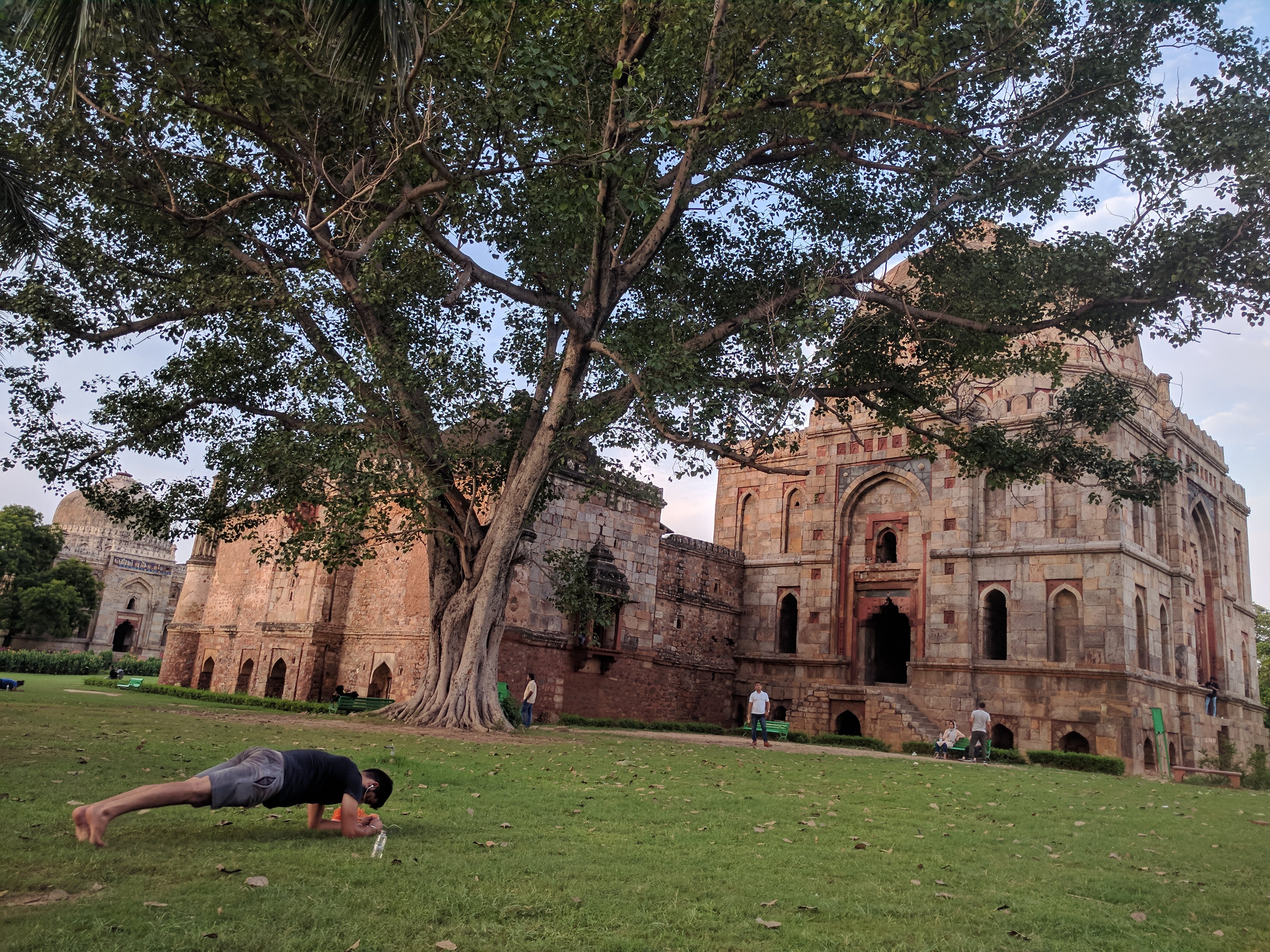
Lodi Garden is a city park situated in New Delhi. Spread over 90 acres (360,000 m2),it contains Muhammad Shah’s tomb, the tomb of Sikandar Lodi, the Shisha Gumbad and the Bara Gumbad. These monuments date from the late Delhi Sultanate, during the Sayyid dynasty (r. 1414–1451) and Lodi dynasty (r. 1451–1526). At this time, the Delhi Sultanate’s territory included parts of present-day North India and the Pakistani provinces of Punjab and Khyber Pakhtunkhwa.
As there is little architecture dating to the Sayyid and the Lodi periods still standing, Lodi Gardens is an important archaeological site, and is protected by the Archaeological Survey of India (ASI).The gardens are situated between Khan Market and Safdarjung’s Tomb on Lodi Road and are a popular spot for morning walks for Delhiites.
3.Salimgarh Fort

Salimgarh Fort (also known as Salim’s Fort) was built in 1546 CE in Delhi, on what was then an island of the Yamuna River, by Salim Shah Suri, the son of Sher Shah Suri. The fort was constructed during a period when the Mughal Empire had been temporarily overthrown; in 1540 CE, Sher Shah Suri had defeated the Mughal emperor Humayun and established the rule of the Sur Empire rule in Delhi. The Surid dynasty continued until 1555 CE, when Humayun regained control by defeating Sikandar Suri, the last ruler of the dynasty.
During the Mughal period, particularly in later years, Salimgarh Fort continued to be of strategic significance. While constructing the Red Fort and the city of Shahjahanbad, several Mughal rulers, including Emperor Shah Jahan—who completed Shahjahanabad in 1639 CE—are believed to have camped at the fort. It is also said that Humayun camped there for three days before launching his successful campaign to recapture Delhi.
The Mughal emperor Aurangzeb later converted the fort into a prison, a practice that was continued by the British after they took control of the fort in 1857. Salimgarh Fort is now part of the Red Fort Complex. The complex was declared a UNESCO World Heritage Site in 2007, obligating the Archaeological Survey of India (ASI) to undertake well-planned conservation measures for its preservation .
4.Purana Qila
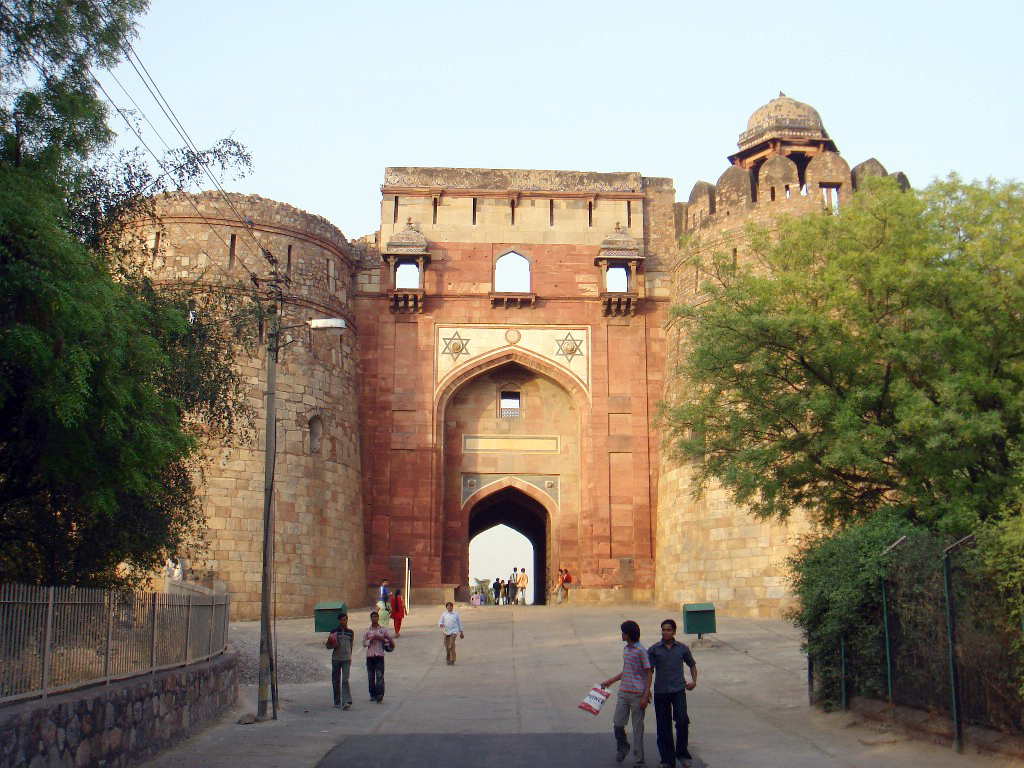
Purana Qila (lit. ’Old Fort’) is one of the oldest forts in Delhi, India. It was built by the second Mughal Emperor Humayun and Surid Sultan Sher Shah Suri. The fort forms the inner citadel of the city of Dinpanah. It is located near the expansive Pragati Maidan exhibition ground and is separated from Dhyanchand Stadium by Mathura Road, Delhi.
Excavations point to traces and continued habitation from the 1000 BC, during the Painted Grey Ware period. The first two rounds of excavations – in 1954–55 and 1969–72 – by B. B. Lal, then director of the Archaeological Survey of India (ASI), had unearthed traces of Painted Grey Ware culture. Historian Alexander Cunningham identified the fort with that of Indraprastha, though he referred to the present structure as built by Muslim rulers. Even till the early part of the 20th century, Purana Qila was known as Pandavon Ka Qila (Pandava’s fort) and the entire complex as Indraprastha village. It must be remembered that coordinating material archaeological culture with literary and bardic literature is methodologically almost always impossible.
5.Humayun’s Tomb

Humayun’s tomb (Persian: Maqbara-i Humayun) is the tomb of Mughal Emperor Humayun situated in Delhi, India. The tomb was commissioned by Humayun’s first wife and chief consort, Empress Bega Begum under her patronagein 1558, and designed by Mirak Mirza Ghiyas and his son, Sayyid Muhammad, Persian architects chosen by her. It was the first garden-tomb on the Indian subcontinent, and is located in Nizamuddin East, Delhi, close to the Dina-panah Citadel, also known as Purana Qila (Old Fort), that Humayun found in 1538.
It was also the first structure to use red sandstone at such a scale. The tomb was declared a UNESCO World Heritage Site in 1993,and since then has undergone extensive restoration work, which is complete. Besides the main tomb enclosure of Humayun, several smaller monuments dot the pathway leading up to it, from the main entrance in the West, including one that even pre-dates the main tomb itself, by twenty years; it is the tomb complex of Isa Khan Niazi, an Afghan noble in Sher Shah Suri’s court of the Sur Empire, who fought against the Mughals, constructed in 1547 CE.
The complex encompasses the main tomb of the Emperor Humayun, which houses the graves of Empress Bega Begum, Hajji Begum, and also Dara Shikoh, great-great-grandson of Humayun and son of the later Emperor Shah Jahan, as well as numerous other subsequent Mughals, including Emperor Jahandar Shah, Farrukhsiyar, Rafi Ul-Darjat, Rafi Ud-Daulat, Muhammad Kam Bakhsh and Alamgir II.It represented a leap in Mughal architecture, and together with its accomplished Charbagh garden, typical of Persian gardens, but never seen before in India, it set a precedent for subsequent Mughal architecture.
It is seen as a clear departure from the fairly modest mausoleum of his father, the first Mughal Emperor, Babur, called Bagh-e Babur (Gardens of Babur) in Kabul (Afghanistan). Though the latter was the first Emperor to start the tradition of being buried in a paradise garden.Modelled on Gur-e Amir, the tomb of his ancestor and Asia’s conqueror Timur in Samarkand, it created a precedent for future Mughal architecture of royal mausolea, which reached its zenith with the Taj Mahal, at Agra.
The site was chosen on the banks of Yamuna River, due to its proximity to Nizamuddin Dargah, the mausoleum of the celebrated Sufi saint of Delhi, Nizamuddin Auliya, who was much revered by the rulers of Delhi, and whose residence, Chilla Nizamuddin Auliya lies just north-east of the tomb. In later Mughal history, the last Mughal Emperor, Bahadur Shah Zafar took refuge here, during the Indian Rebellion of 1857, along with three princes, and was captured by Captain Hodson before being exiled to Rangoon. At the time of the Slave Dynasty this land was under the ‘KiloKheri Fort’ which was capital of Sultan Qaiqabad, son of Nasiruddin (1268–1287).
The Tombs of Battashewala Complex lie in the buffer zone of the World Heritage Site of the Humayun Tomb Complex; the two complexes are separated by a small road but enclosed within their own separate compound wall.
6. Red Fort
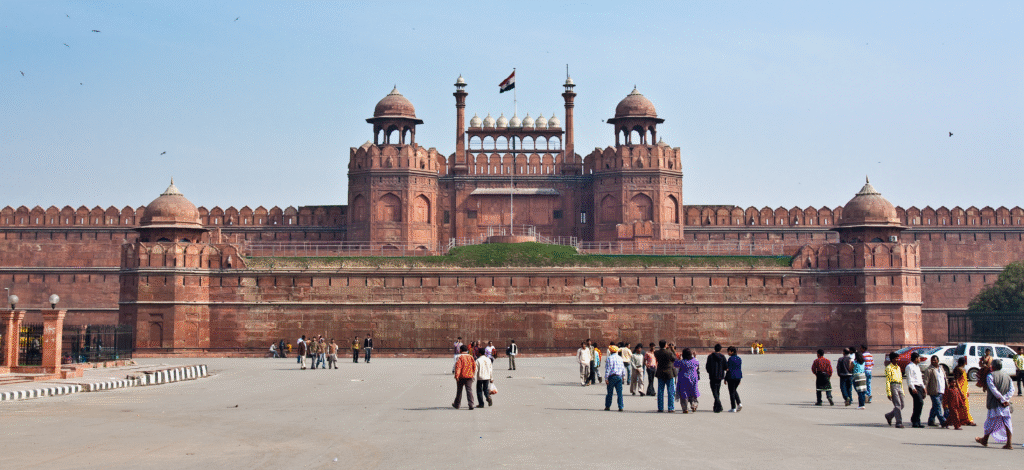
The Red Fort, also known as Lal Qila (Hindustani: [laːl ‘qɪlaː]) is a historic Mughal fort located in the Old Delhi area of Delhi, India. It served as the main residence of the Mughal emperors. Commissioned by Emperor Shah Jahan on the 12th of May 1639, the fort was constructed following his decision to shift the Mughal capital from Agra to Delhi. Originally adorned in red and white, the fort’s design is attributed to Ustad Ahmad Lahori, the architect of the Taj Mahal. The Red Fort is a prominent example of Mughal architecture from Shah Jahan’s reign, combining Persian and Indian architectural styles.
During the invasion by Nadir Shah of the Afsharid Empire in 1739, the fort was plundered and stripped of its artwork and jewels. Following the Indian Rebellion of 1857, many of its marble structures were demolished by the British, although the defensive walls remained largely intact. The fort was later repurposed as a military garrison.
On 15 August 1947, the first Prime Minister of India, Jawaharlal Nehru, hoisted the Indian flag above the Lahori Gate, the main entrance of the Red Fort. Since then, the Prime Minister of India has ceremonially raised the national tricolour at the main gate each year on Independence Day, then delivering a nationally broadcast address from its ramparts.
The Red Fort, as part of the Red Fort Complex, was recognized as a UNESCO World Heritage Site in 2007.
7.Tomb of Safdar Jang
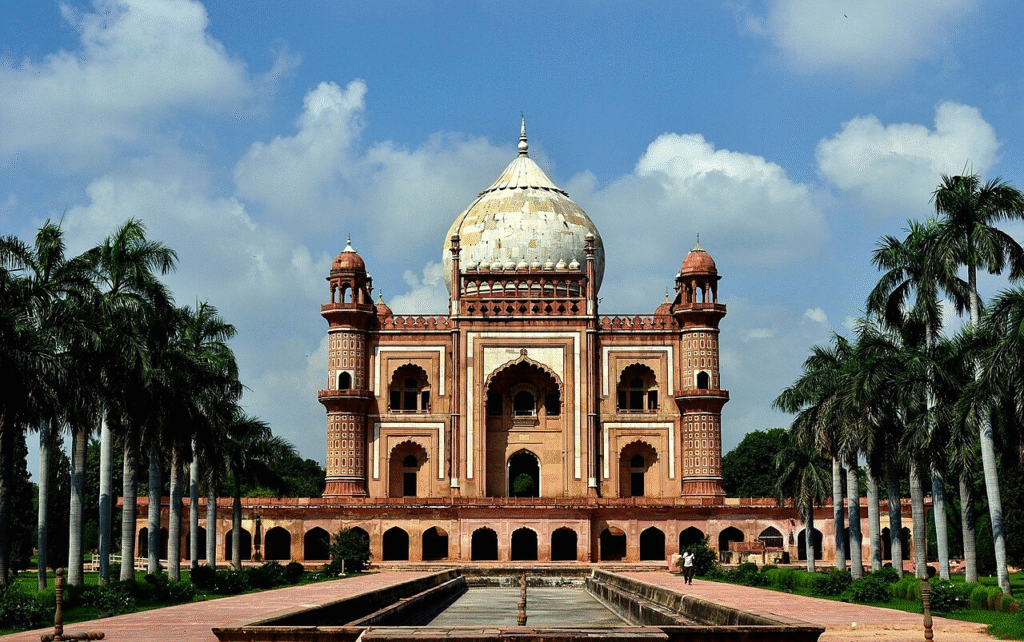
Safdarjung’s tomb is a sandstone and marble mausoleum in Delhi, India. It was built in 1754 in the late Mughal Empire style for Nawab Safdarjung. The monument has an ambience of spaciousness and an imposing presence with its domed and arched red, brown and white coloured structures. Safdarjung, Nawab of Awadh, was made prime minister of the Mughal Empire (Wazir ul-Mamlak-i-Hindustan) when Ahmed Shah Bahadur ascended the throne in 1748.
The tomb, within a garden, is in a late version of the style of earlier Mughal imperial tombs, most famously the Taj Mahal, with inside “eight paradises” (hasht bihisht) or eight rooms around the main chamber under the dome, and a garden divided into four parts outside. This was the first time someone outside the immediate imperial Mughal family built themselves such a tomb and garden complex, reflecting the greatly diminished powers of the emperors by this date.
8. Jantar Mantar
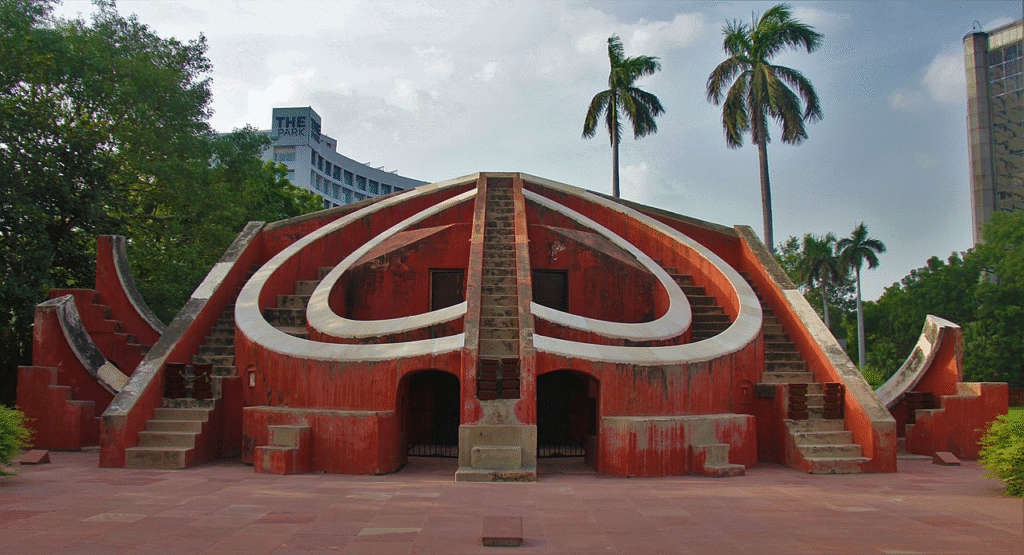
Jantar Mantar in New Delhi is an observatory, designed to be used with the naked eye. It is one of five Jantar Mantar in India. “Jantar Mantar” means “instruments for measuring the harmony of the heavens”. It consists of 13 architectural astronomy instruments.
The site is one of five built by Maharaja Jai Singh II of Jaipur, from 1723 onwards, revising the calendar and astronomical tables. Jai Singh, born in 1688 into a royal Rajput family that ruled the regional kingdom, was born into an era of education that maintained a keen interest in astronomy. There is a plaque fixed on one of the structures in the Jantar Mantar observatory in New Delhi that was placed there in 1910 mistakenly dating the construction of the complex to the year 1710. Later research, though, suggests 1724 as the actual year of construction. Its height is 723 feet (220 m).
The primary purpose of the observatory was to compile astronomical tables, and to predict the times and movements of the Sun, Moon and planets. Some of these purposes nowadays would be classified as astronomy.
Completed in 1724, the Delhi Jantar Mantar had decayed considerably by 1857 uprising. The Ram Yantra, the Samrat Yantra, the Jai Prakash Yantra and the Misra Yantra are the distinct instruments of Jantar Mantar. The most famous of these structures, the Jaipur, had also deteriorated by the end of the nineteenth century until in 1901 when Maharaja Ram Singh set out to restore the instrument.
9.Iron pillar of Delhi
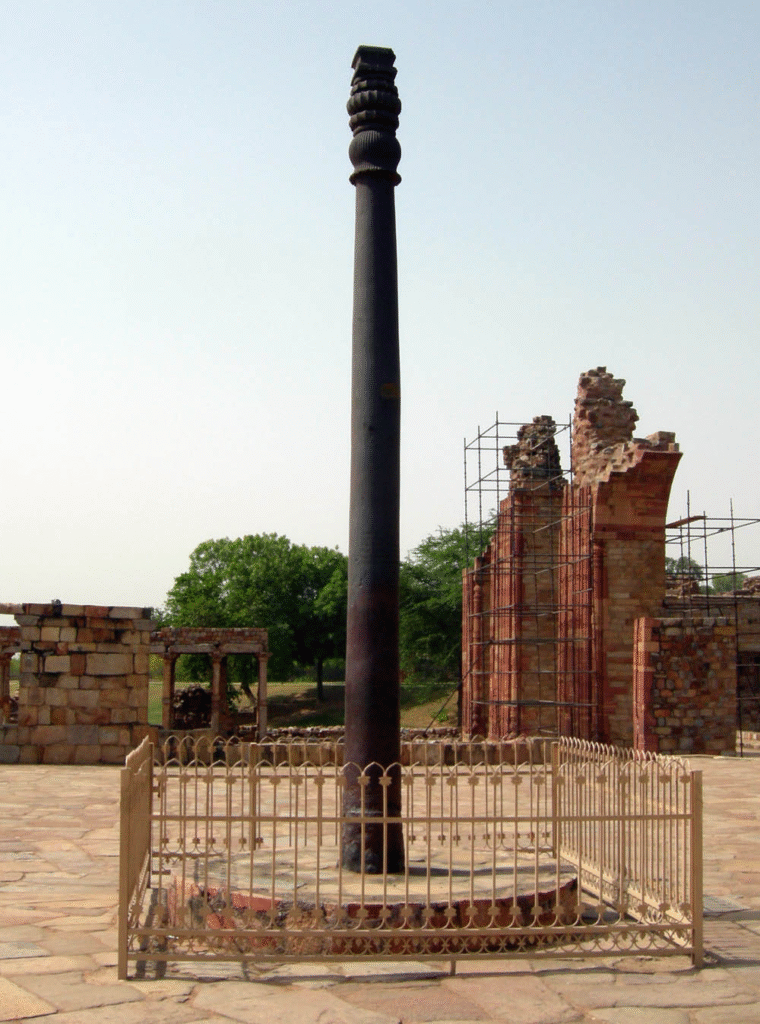
The Iron pillar of Delhi is a metal structure 7.21 metres (23 feet 8 inches) high with a 41-centimetre (16 in) diameter that was constructed by Chandragupta II (reigned c. 375–415 CE), and now stands in the Qutb complex at Mehrauli in Delhi, India.
The metals used in its construction have a rust-resistant composition. The pillar weighs more than six tonnes and is thought to have been erected elsewhere, possibly outside the Udayagiri Caves, and moved to its present location by Anangpal Tomar in the 11th century.
The height of the pillar, from the top to the bottom of its base, is 7.21 m (23 ft 8 in), 1.12 m (3 ft 8 in) of which is below ground. Its bell pattern capital is 306 mm (12 in). It is estimated to weigh more than six tonnes (13,000 lb).The pillar has attracted the attention of archaeologists and materials scientists because of its high resistance to corrosion and has been called a “testimony to the high level of skill achieved by the ancient Indian iron smiths in the extraction and processing of iron”.
The corrosion resistance results from an even layer of crystalline iron(III) hydrogen phosphate hydrate forming on the high-phosphorus-content iron, which serves to protect it from the effects of the Delhi climate.
10.Swaminarayan Akshardham
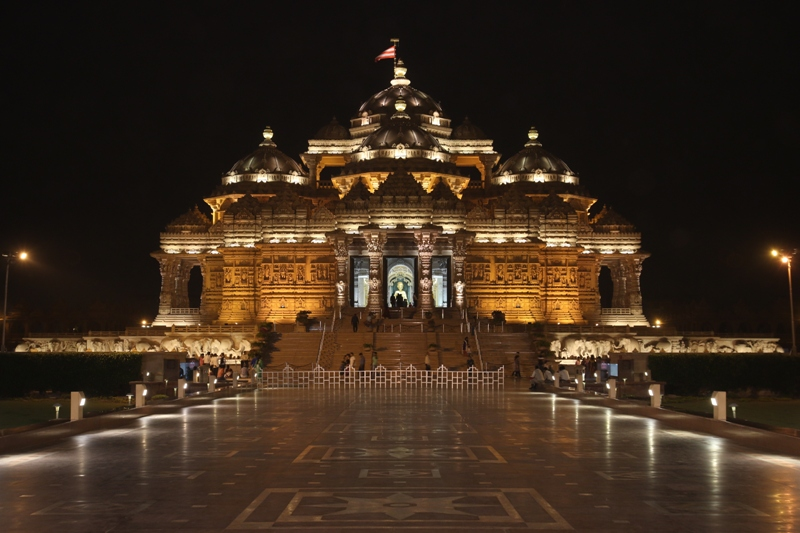
Swaminarayan Akshardham is a Hindu temple and campus in Delhi, India. The temple is close to the border with Noida. Also known as Akshardham Temple or Akshardham Delhi, the complex displays traditional and modern Hindu culture and architecture. Inspired by Yogiji Maharaj and created by Pramukh Swami Maharaj, it was constructed by BAPS. It is the world’s second-largest BAPS Hindu temple, following Akshardham, New Jersey, in the United States.
The temple was opened on 6 November 2005 by Pramukh Swami Maharaj in the presence of A. P. J. Abdul Kalam, Manmohan Singh, L.K Advani and B.L Joshi.The temple, at the centre of the complex, was built according to the Vastu shastra and Pancharatra shastra.
In Swaminarayan Akshardham, similar to its predecessor in Gandhinagar, Gujarat, the main shrine is the focal point of the complex. Exhibition halls provide information about the life and work of Swaminarayan.
The complex features an abhishek mandap, Sahaj Anand water show, a thematic garden, and three exhibitions namely Sahajanand Darshan (Hall of Values), Neelkanth Darshan (an IMAX film on the early life of Swaminarayan as the teenage yogi, Nilkanth), and Sanskruti Darshan (cultural boat ride). According to Swaminarayan Hinduism, the word Akshardham means the abode of Swaminarayan and believed by followers as a temporal home of God on earth.
Jama Masjid

The Masjid-i-Jehan-Numa, commonly known as the Jama Masjid, in Old Delhi area of Delhi, is one of the largest mosques in India. Its builder was the Mughal emperor Shah Jahan, between 1644 and 1656, and it was inaugurated by its first Imam, Syed Abdul Ghafoor Shah Bukhari.
Situated in the Mughal capital of Shahjahanabad (today Old Delhi), it served as the imperial mosque of the Mughal emperors until the demise of the empire in 1857. The Jama Masjid was regarded as a symbolic gesture of Mughal power across India. It was also a site of political significance during several key periods of British rule. It remains in active use, and is one of Delhi’s most iconic sites, closely identified with the methods of Old Delhi. The mosque structure is a Monument of National Importance.