
The Telangana Tourism Development Corporation is a state government agency which promotes Tourism in Telangana, a state in the Southern region of India. The retired Director General of Police Pervaram Ramulu is the appointed First chairman of Telangana State Tourism. Tourist attractions in Telangana include historical places, monuments, forts, waterfalls, forests and temples. Hyderabad tourist point . The Hyderabad tourism destination for Charminar, Mecca Masjid, Qutb Shahi Tombs, Golconda Fort ,Qutub Shahi tombs, etc.
Hyderabad, the state capital, placed 2nd in Traveler Magazine’s best places to see in the world in 2015.
Hyderabad is the capital and largest city of the South Indian state of Telangana. It was ruled by the Qutub Shahis, Mughals and the Nizams which shaped its history. The city is noted for its monuments which includes the masterpiece of Charminar and the fort of Golconda. There are a multitude of masjids, temples, churches and bazaars in the city.
The tourism industry forms an important role in the economy of Hyderabad. Tourism-related fairs are held regularly, and in 2010, the city was listed among the Beta- World City by the global city index produced by GaWC, and in 2011 the city was rated 19th in the world by The New York Times in The list of 41 Places to Go in 2011. As of 2011, the tourism promotion budget for the city was increased to ₹ 520 million.
Telangana, which is India’s top domestic tourist destination, receives up to 157 million visits,[ and reached 1.5 million international tourists, which generated US$23 million in revenue. The city houses famous historical sites including Charminar, UNESCO Asia Pacific Heritage site of the Chowmahalla Palace,Salar Jung Museum (among the world’s largest private collection museums) as well as art galleries, libraries, sports complexes, museums and theaters. It is the place of nawabs.
Hyderabad is known as The City of Pearls, as once it was the only global centre for trade of large diamonds, emeralds and natural pearls. Many traditional and historical bazaars are located around the city. The Laad Bazaar situated near Charminar has shops that sell pearls, jewellery and products such as silverware, Nirmal, Kalamkari paintings and artefacts, bidriware, lacquer bangles studded with stones, saris, handwoven materials in silk and cotton. The following is a list of tourist attractions in Hyderabad.
Hyderabad tourist point
Historical monuments
1.Charminar

a major landmark of Hyderabad with four graceful minarets located in the old city. It was built by Muhammed Quli Qutb Shah as a memorial for plague victims and was the tallest structure in Hyderabad for nearly 400 years. Charminar, on most occasions, is used to represent the city and the state and is hailed as a unique Deccan monument. It is in the midst of Charkaman which are four archways to roads leading in all four directions from the Charminar monument.
2.Mecca Masjid
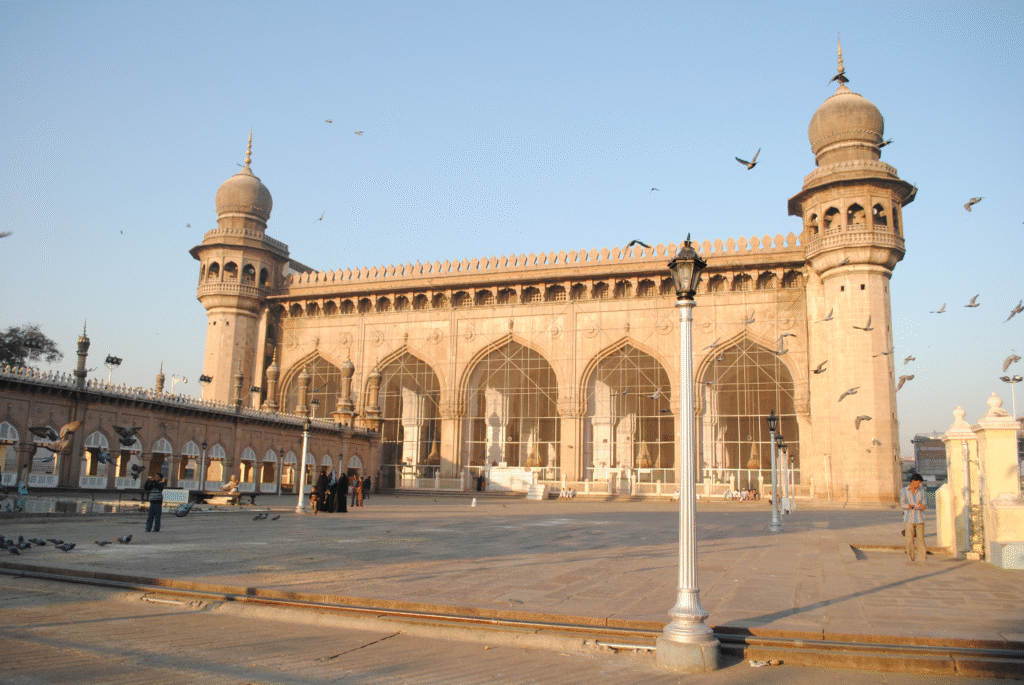
- A symbolic mosque, Mecca Masjid was built 400 years ago during the reign of Sultan Muhammad Qutub Shah, the 6th Qutub Shahi Sultan of Hyderabad. The three-arched facade has been carved from a single piece of granite, which took five years to quarry. More than 8,000 workers were employed to build the mosque. Muhammed Qutub Shah personally laid the foundation stone.
Jean-Baptiste Tavernier, the French explorer, in his travelogue observed, “It is about 50 years since they began to build a splendid pagoda in the town which will be the grandest in all India when it is completed. The size of the stone is the subject of special accomplishment, and that of a niche, which is its place for prayer, is an entire rock of such enormous size that they spent five years in quarrying it, and 500 to 600 men were employed continually on its work. It required still more time to roll it up on to conveyance by which they brought it to the pagoda; and they took 1400 oxen to draw it”.
3.Qutb Shahi Tombs

The Qutub Shahi tombs are a series of Islamic tombs and mosques built by the various kings of the Qutub Shahi dynasty, located in the Ibrahim Bagh (garden precinct), close to the famous Golconda Fort in Hyderabad, in the Hyderabad district of the state of Telangana, India.
A stunning and concentrated example of Indo-Islamic and Qutb Shahi architecture, the galleries of the smaller tombs are of a single storey while the larger ones are two-storied. In the centre of each tomb is a sarcophagus which overlies the actual burial vault in a crypt below. The domes were originally overlaid with blue and green tiles, of which only a few pieces now remain.
The tomb complex forms part of the Golkonda Fort, Fortifications, a Monument of National Importance, administered by the Archaeological Survey of India. In 2014, UNESCO placed the complex on its “tentative list” to become a World Heritage Site, with others in the region, under the name Monuments and Forts of the Deccan Sultanate (despite there being a number of different sultanates).
4.Golconda Fort
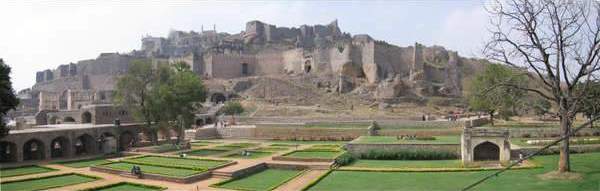
Golconda is a fortified citadel and ruined city located on the western outskirts of Hyderabad, Telangana, India. The fort was originally built by Kakatiya ruler Pratāparudra in the 11th century out of mud walls.It was ceded to the Bahmani Kings from Musunuri Nayakas during the reign of the Bahmani Sultan Mohammed Shah I, during the first Bahmani-Vijayanagar War.
Following the death of Sultan Mahmood Shah, the Sultanate disintegrated and Sultan Quli, who had been appointed as the Governor of Hyderabad by the Bahmani Kings, fortified the city and made it the capital of the Golconda Sultanate. Because of the vicinity of diamond mines, especially Kollur Mine, Golconda flourished as a trade centre of large diamonds known as Golconda Diamonds. Golconda fort is currently abandoned and in ruins. The complex was put by UNESCO on its “tentative list” to become a World Heritage Site in 2014, with other forts in the region, under the name Monuments and Forts of the Deccan Sultanate (despite there being a number of different sultanates).
5.Qutub Shahi tombs
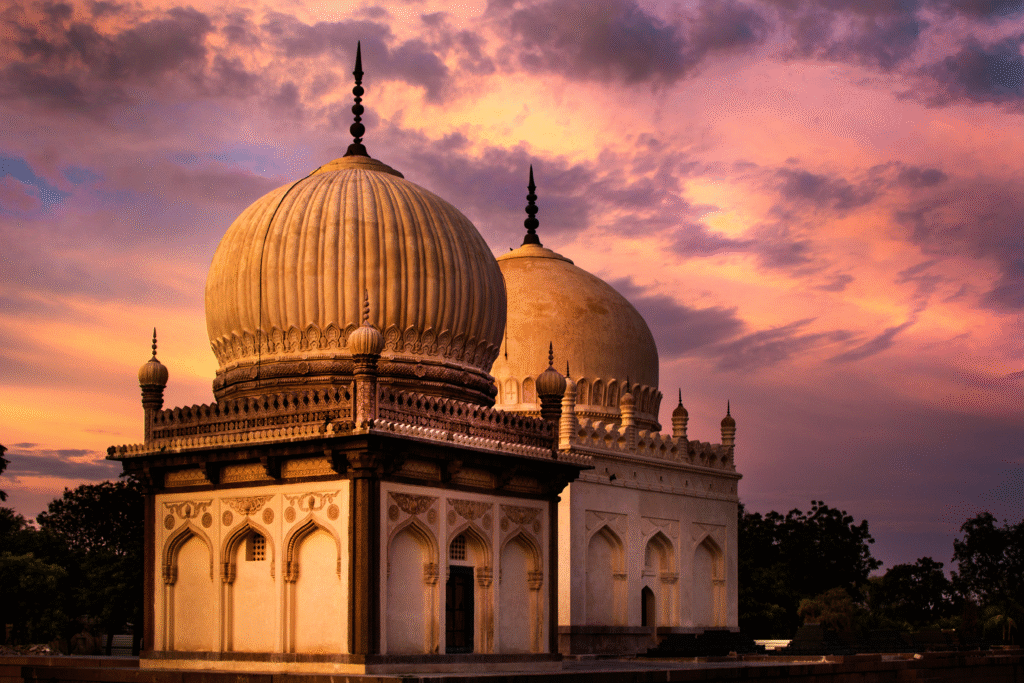
The Qutub Shahi tombs are a series of Islamic tombs and mosques built by the various kings of the Qutub Shahi dynasty, located in the Ibrahim Bagh (garden precinct), close to the famous Golconda Fort in Hyderabad, in the Hyderabad district of the state of Telangana, India.
A stunning and concentrated example of Indo-Islamic and Qutub Shahi architecture, the galleries of the smaller tombs are of a single storey while the larger ones are two-storied. In the centre of each tomb is a sarcophagus which overlies the actual burial vault in a crypt below. The domes were originally overlaid with blue and green tiles, of which only a few pieces now remain.
The tomb complex forms part of the Golkonda Fort, Fortifications, a Monument of National Importance, administered by the Archaeological Survey of India. In 2014, UNESCO placed the complex on its “tentative list” to become a World Heritage Site, with others in the region, under the name Monuments and Forts of the Deccan Sultanate (despite there being a number of different sultanates).
6.Paigah Tombs
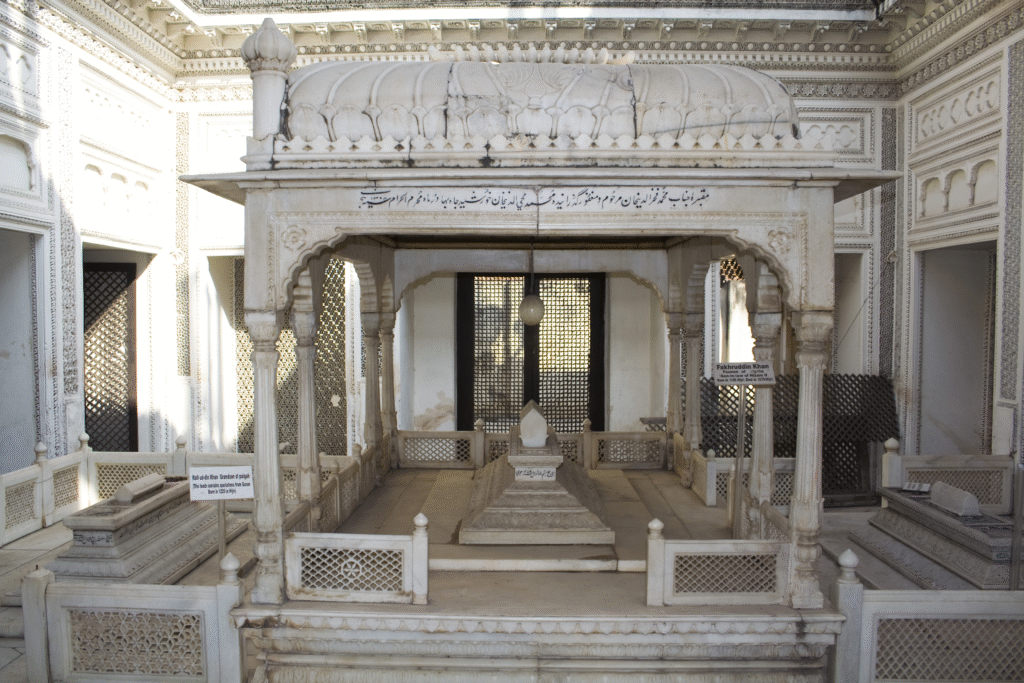
Paigah Tombs or Maqhbara Shams al-Umara, are the tombs belonging to the nobility of Paigah family, who were fierce loyalists of the Nizams, served as statespeople, philanthropists and generals under and alongside them. The Paigah tombs are among the major wonders of Hyderabad State which are known for their architectural excellence as shown in their laid mosaic tiles and craftsmanship. Since it was Amir-e-Kabir H.E. Nawab Sir Khursheed Jah Bahadur who built the Paigah Tombs, he gave special preference in terms of construction to his immediate family. Of all the arches at Paigah Tombs, it is only the arch of his family’s tomb that is bigger compared to the others.
The entire necropolis was built earlier then the architecture would have been the same for all the tombs but instead in terms of architectural beauty, the tomb of Nawab Sir Khursheed Jah’s family was given special preference. The largest arch and the double maqbara inside known as “Mahajar” cannot be seen inside any other tomb and also to mention the beautifully decorated stucco work in the tomb of Lateefunnisa Begum Saheba (Grandmother of Sir Khursheed Jah) is not found in any other tomb. The tombstone of Lateefunnisa Begum Saheba, on which is already mentioned was built by Nawab Sir Khursheed Jah Bahadur. “Lateefunnisa Begum Saheba Jid’de Mohammed Mohiuddin Khan Khursheed Jah Tayyari ye Mohammed Mohiuddin Khan Khursheed Jah Bahadur.”
The word “Jid’de” over here would mean Grandmother of Sir Khursheed Jah Bahadur and “Tayyari’ye Mohammed Mohiuddin Khan Khursheed Jah Bahadur” would mean “Prepared by Khursheed Jah Bahadur.” Inside this tomb are the graves of Nawab Sir Khursheed Jah Bahadur’s immediate family members. Shahzadi Hussainunnisa Begum (Wife), Shahzadi Hashmatunnisa Begum (Mother), Amir-e-Kabir Nawab Mohammed Rasheeduddin Khan Bahadur (Father) and Hussaini Begum (second wife of Nawab Rasheeduddin Khan).
The Paigah’s necropolis is located in a quiet neighbourhood 4 km southeast of Charminar Hyderabad, at Phisal banda suburb, down a small lane across from Owaisi Hospital near Santosh Nagar. These tombs are made out of lime and mortar with beautiful inlaid marble carvings. These tombs are 200 years old and represent the final resting places of several generations of the Paigah Nobles.

At first, Paigah Tombs may look deserted and uncared for, but on a closer look, you will find the place quite enthralling. With marvellous carvings and motifs in floral designs and inlaid mosaic tile works, the tombs are exquisite to walk around. The tombs and their walls are delicately carved and enclosed in pierced marble facades, some of them in rows and some with beautifully carved screens and canopies.
The place is easily approachable and is set amidst a labyrinth of concrete houses built around the 30 acres of property in which the tombs are nestled. They are almost obscure and a marvellous piece of artistry in marble lost in time. The Indo-Islamic architecture is a mix of both the Asaf Jahi and the Rajputana styles of architecture. You will also see décor in fabulous stucco work, representing the Mughal, Persian and Deccan styles too.
7.Spanish Mosque
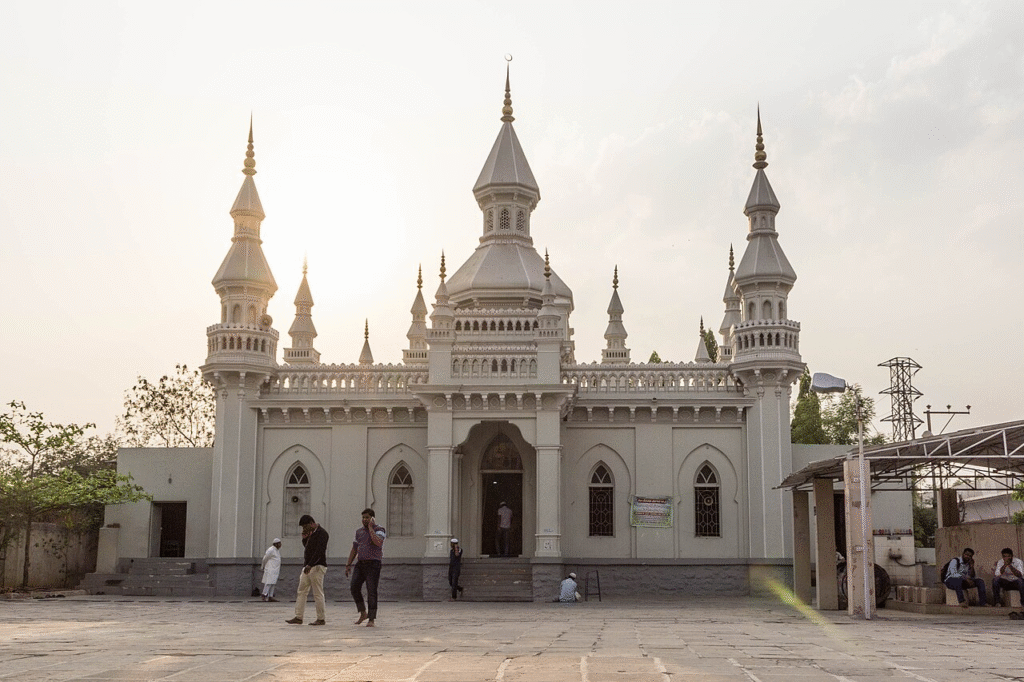
The Spanish Mosque, also known as the Masjid Iqbal Ud Daula and the Jam e Masjid “Aiwan-E-Begumpet”, is a mosque within Paigah Palace, in the Begumpet neighbourhood of Hyderabad, in the Hyderabad district of the state of Telangana, India.
It is also known as the Mosque of the Moors, due to its unique Moorish Revival architectural style and is said to be one-of-its-kind in India.
The construction of the mosque was started by the fifth Paigah Amir, H.E. Nawab Mohammed Fazaluddin Khan, Iqbal Ud Daula, Sir Viqar-ul-Umra in 1900 (due to his sudden demise in 1902) and completed by his heir and elder son H.E Nawab Sultan Ul Mulk Bahadur, VI Amir of Paigah through Princess Jahandarunissa Begum, Lady Vicar Ul Umra.
After his return from Spain, Viqar-ul-Umra was very much inspired by the Cathedral–Mosque of Córdoba. The exterior and interior of the Spanish Mosque are mostly similar to the Cathedral–Mosque and Jama Masjid Gulbarga, in Karnataka, India. The mosque shows state-of-the-art interiors and architecture. The stand-out feature is the spires instead of the usual minarets or domes; they give this mosque a church-like appearance.
The mosque is maintained and managed by the heirs of Paigah Amir Sir Viqar-ul-Umra.
The mosque can accommodate 3,000 worshipers at once. The Spanish Mosque is very well known and is considered as a landmark mosque for the Secunderabad Muslim community.
The Spanish Mosque is a declared heritage site by ASI[clarification needed] and is under discussion for the consideration of UNESCO Asia Pacific Merit.
8.Hayat Bakshi Mosque, Hayathnagar

The Hayat Bakshi Mosque also Hayat Bakshi Begum Masjid is a mosque located in Hayathnagar, near Hyderabad, in the Hyderabad district of the state of Telangana, India. It was constructed in 1672 during the reign of Abdullah Qutb Shah the fifth Sultan of Golconda, and named after Hayat Bakshi Begum.
The mosque is built in typical Qutb Shahi style; with the Sarai, a rest house for the weary travellers. The façade features five arches, two minarets as well as a frieze and parapet which runs around the twelve-sided arcaded galleries protruding from the corner minarets. The prayer hall is set on a raised platform. Toward the eastern side of the platform and below the mosque is an ablution tank.
The large complex occupies nearly 2.0 hectares (5 acres). The caravan sarai (rest house) is a 150 by 130 metres (490 by 430 ft) courtyard. This guest house is said to have 130 rooms. Hathi Bawli (meaning well of elephant), is a very large well on the north-east of the mosque.
9. Falaknuma Palace

Falaknuma is a former palace and currently a luxury hotel in Hyderabad, Telangana, India. It originally belonged to the Paigah family, and was later owned by the Nizam of Hyderabad. It is on a hillock and covers a 13-hectare (32-acre) area in Falaknuma, 5 kilometres (3.1 mi) from Charminar.
Built by Nawab Sir Viqar-ul-Umra, Prime Minister of Hyderabad state and the uncle and brother-in-law of the sixth Nizam. Falak-numa means “Like the Sky” or “Mirror of Sky” in Urdu. At the time of its completion in 1893, it was the tallest building in Hyderabad
The palace post renovation carried out in 2010 today is a part of Taj Group and has been renamed as Taj Faluknama Palace.
10. Chowmahalla Palace

Chowmahalla Palace or Chowmahallat is the palace of the Nizams of Hyderabad State located in Hyderabad, Telangana, India. It was the seat of power of the Asaf Jahi dynasty (1720-1948) and was the official residence of the Nizams during their reign. The palace has been converted into a museum and the ownership still lies with the family.
The palace was constructed at the location of an earlier palace of the Qutb Shahi dynasty and Asaf Jahi dynasty close to the Charminar. Construction of the palace, as it stands today, was started by Nizam Ali Khan Asaf Jah II in 1769. He ordered the building of four palaces from which the nomenclature of Chau Mahalla is derived. The word chār or chahār, and its variation chow, means “four” and the word mahal means “palace” in Urdu, Hindi and Persian.